Sepsis Survivors

Being discharged from the hospital is a good day for most people, but it can also be stressful. Post-sepsis life can have challenges, especially if you have been left with long-term problems related to your illness. Some sepsis survivors recover completely and resume their lives, while others may struggle to cope, something no one expected.

Here you can find information to help you navigate post-sepsis life.

Starting in 2019, Sepsis Alliance added to the awareness efforts by launching Sepsis Survivor Week, which focuses on the survivors and the challenges they may face. Click here to learn more about Sepsis Survivor Week.

FAQ

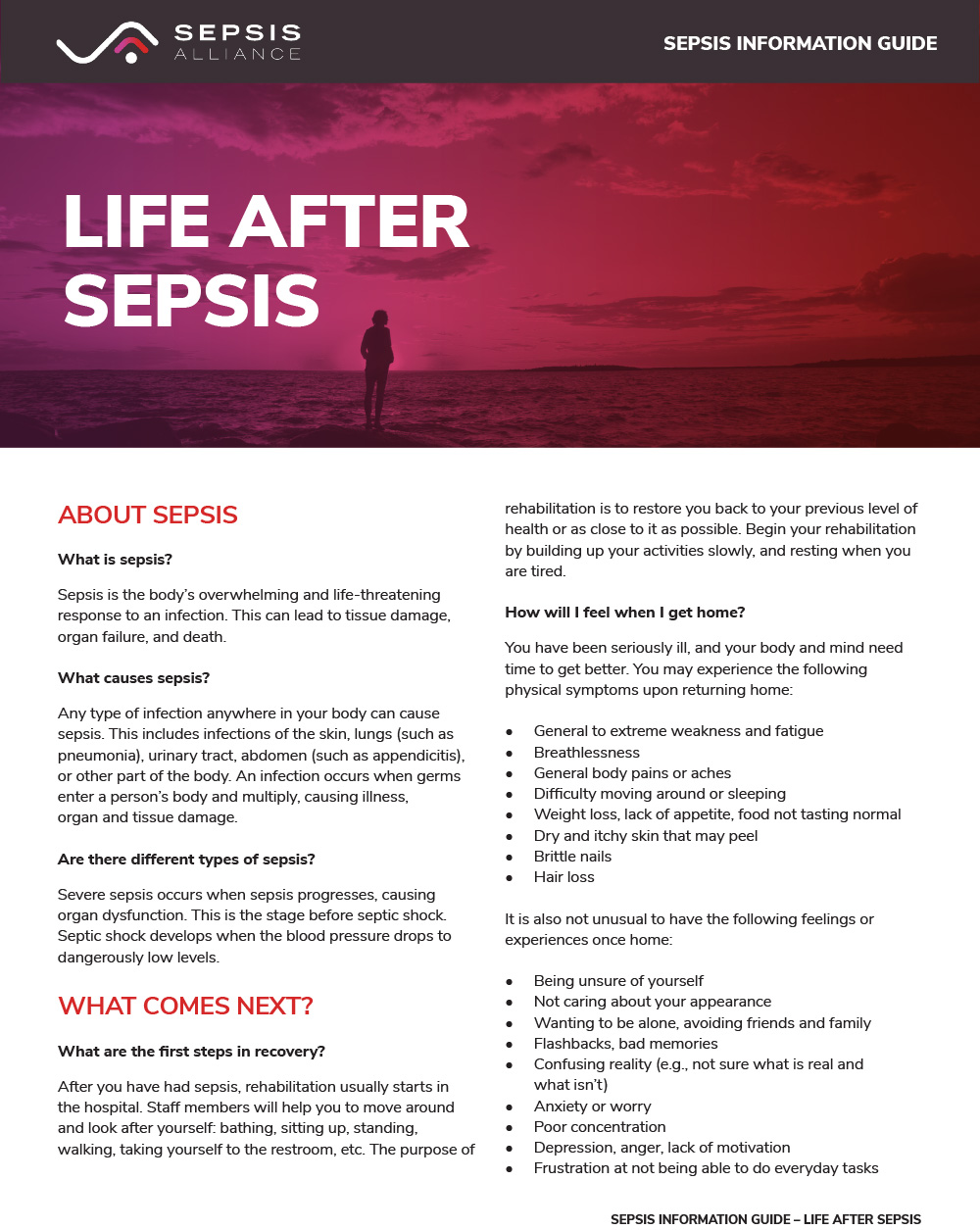
Our Frequently Asked Questions (FAQ) section addresses many questions related to sepsis and life after sepsis. Survivors and their family and friends can find answers to questions, such as can I get sepsis again, why am I so tired, and can sepsis be prevented? You may also find our Life After Sepsis Information Guide helpful in explaining some of the issues that could last long after discharge from the hospital.

KNOW THE SEPSIS FACTS

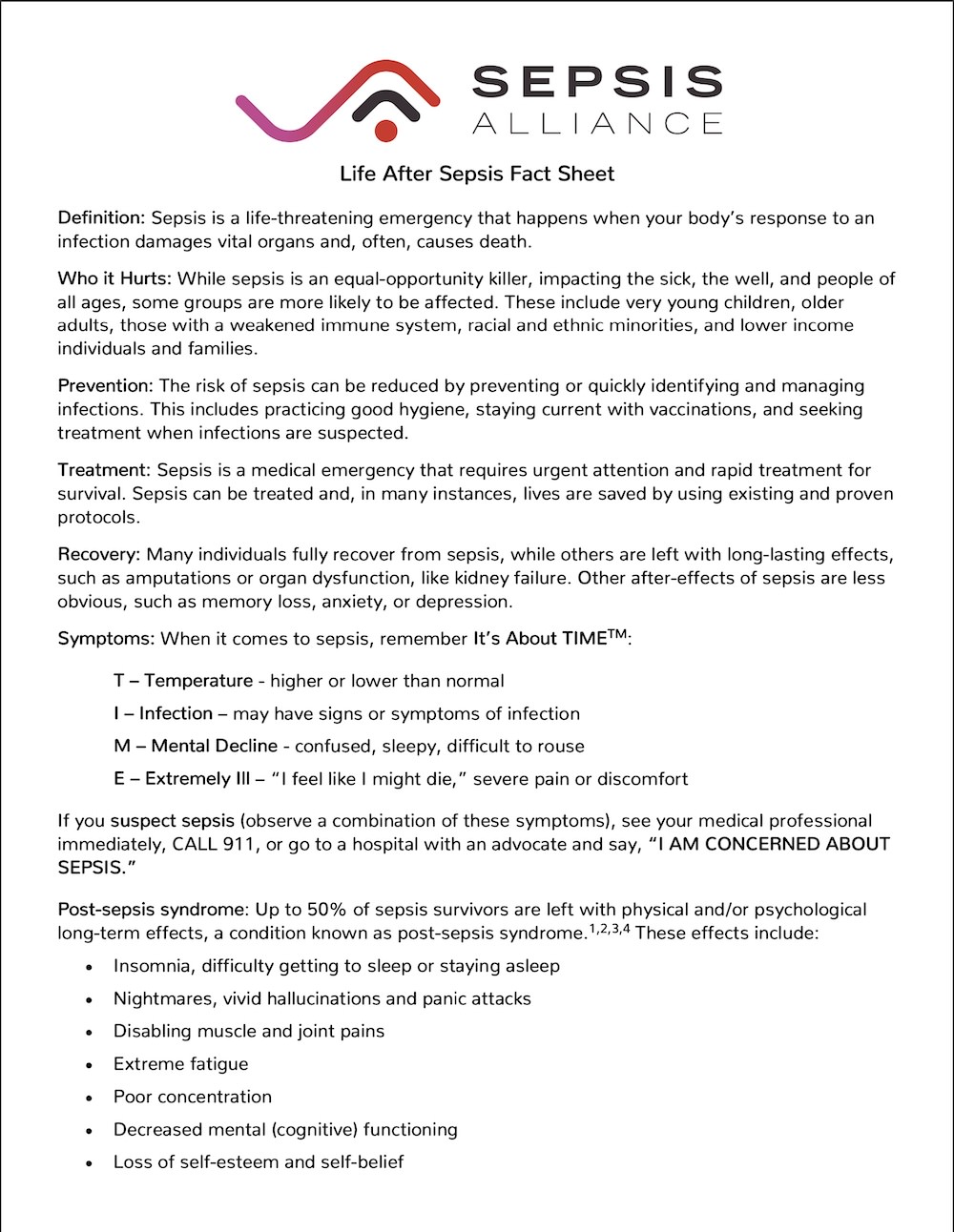
Many researchers are working to learn more about what causes sepsis, how it affects patients, and life after sepsis. Learn more about the facts and statistics in the Life After Sepsis Fact Sheet.

AFTER DISCHARGE FROM THE HOSPITAL

Once you have been discharged from the hospital, it may seem that you’ve been left to fend for yourself. Discharge instructions are sometimes rushed or may be incomplete, or you may not think of the questions you need to ask. To help you with the hospital to home or hospital to rehab transition, Sepsis Alliance has put together a checklist with the most common issues that come up. Click here for the list.

We have also created a discharge kit for those being released from the hospital after COVID-19. Download the guide here.

Since sepsis survivors are at risk for repeat infections, you should also speak with your doctor about any vaccinations that you may need to reduce the likelihood of getting another infection. You can read about these vaccines at the Centers for Disease Control and Prevention (CDC), the World Health Organization (WHO), and the European Center for Disease Prevention (ECDP), which provide schedules for adults and children. You can also learn more at Prevention: Vaccines. Regaining your health after sepsis can also be slow, but good nutrition can help you along the way. Learn more about nutrition after sepsis here.

CONNECT WITH OTHER SEPSIS SURVIVORS

Sepsis Alliance Connect is a virtual support community designed for the millions of people affected by sepsis. Click here to learn more or to sign up.

LEARNING ABOUT POST-SEPSIS SYNDROME (PSS)

Many people who spend time in an intensive care unit (ICU) develop problems like post-traumatic stress disorder (PTSD). Those who were treated for sepsis may develop not only PTSD, but other problems as well. You can learn more about PSS here and PTSD here.

COPING WITH MENTAL HEALTH ISSUES

Your mental health is a vital part of your overall recovery. If you find yourself struggling with anxiety, depression, or any other mental health issue and you don’t know where to turn, visit our Mental Health Resources page for a list of organizations that may help you.

EXPLAINING POST-SEPSIS ISSUES TO OTHERS

If you are experiencing problems after your discharge, either physical, cognitive, or psychological, you may find it difficult to explain. To help explain post-sepsis issues, Sepsis Alliance has written letters that explain sepsis and PSS to:

CONDITIONS THAT CAN CAUSE SEPSIS

Anyone can develop sepsis, but some people are at higher risk, including sepsis survivors. Learn how sepsis is associated with various conditions, such as diabetes or cancer in our Sepsis and… library.

Updated June 13, 2025.
Video Resources

Faces of Sepsis: Survivor Panel

Presented by sepsis survivors for sepsis survivors, this webinar includes a panel discussion about life after sepsis. Three sepsis survivors will tell their stories and will answer attendee questions about their experiences with sepsis, as well as how they found purpose and returned to life after sepsis.

Septic Shock with Multiple Amputations: A Survivor’s Story

Nicole Ireland

Survivor

Two weeks after giving birth to a beautiful baby girl I ended up in the ER with severe septic shock. (Sepsis and Pregnancy & Childbirth) There were hours the doctors were unsure what was wrong with me and told my husband to prepare for the worst and asked if I would want lifesaving measures taken. I spent 10 days in the hospital, some of that time spent in the ICU after emergency surgery. There was nothing worse than having to be fighting for my life away from my sweet newborn baby girl. Even years later I deal with the reality ... Read Full Story

Submit Your StoryView More Stories

Alyvia C.

Survivor, Survivor

Towards the beginning if this year, I came down with what was believed to be strep. My illness consisted of swollen lymph nodes, tonsils, and a sore throat. I was in bed for days. I began feeling better after I went to an urgent care in my town and started on antibiotics. Stupidly, I didn’t finish my round of antibiotics because I began to feel better. (Sepsis and Strep Throat) About a week later, I started experiencing extreme pain in my left lung. Thinking it was muscle spasms, I ignored it. After suffering from the pain for a week, I ... Read Full Story

Submit Your StoryView More Stories

Kim Schulz

Survivor, Survivor, Survivor

In January of 2022, the pandemic was nearly past us. I was looking forward to working at the local nursing home without wearing a mask. We had begun cautiously lowering our masks for weekly staff meetings. Our nursing home was like many in the US; we had COVID-19 patients alongside others who came to us with severe bacterial infections, including chronic MRSA (methicillin-resistant Staphylococcus aureus) infections. I was disappointed (but not surprised) to see the “plus sign” indicating I had COVID. Others on my team had already been sent home recently for having contracted the virus, but not before passing ... Read Full Story

Submit Your StoryView More Stories

Jillian Uyehara

Survivor, Survivor, Survivor, Survivor

The week of April 22 started as an ordinary busy week for me.  I teach at a preschool during the week, and I am a volunteer first responder, so I had classes each night that week. On Tuesday, we had a stomach virus in my classroom at school, so on Wednesday when I felt nausea hit me at school and some lower left quadrant pain, I was sure the stomach virus had found me. I asked to go home, assuming I would be sick 24 hours and then could resume my work and rescue classes.   On Wednesday and Thursday, ... Read Full Story

Submit Your StoryView More Stories

Jennifer Jay

Survivor, Survivor, Survivor, Survivor, Survivor

In September 2022, my face exploded in open wounds. By November 2022, my body was also covered in open wounds. It took several hours everyday to clean but I was fighting the likelihood of infection. I had a telemed appointment and used antibiotics that seemed to help. All of 2023, I was experiencing flare ups. Uninsured, I would visit the ER it seemed every other month. The flare ups and wounds had evolved. Started to behave differently in Nov. 2023. In the first few days of April,2024, I passed out mid sentence, apparently into a coma, woke up 14 hours ... Read Full Story

Submit Your StoryView More Stories

Help Raise Sepsis Awareness

Many sepsis survivors and loved ones feel the need to help spread sepsis awareness so others don’t go through the same thing. There are many ways you can do this:

Faces of Sepsis

Share your story through our Faces of Sepsis feature. There are more than 1,000 stories from survivors and people who have lost a loved one to sepsis. Sharing your story has three initial benefits. Many survivors and loved ones feel that writing the story down and sharing it allows them to process feelings about their illness and the aftermath. It also helps others, the readers, learn that they aren’t alone.

Too many sepsis survivors think that no one understands what they’ve gone through but when they read these stories, they no longer feel so alone. These stories also show the readers that sepsis can affect anyone – their family, friend, coworker.

Host a talk

Sepsis Alliance has made available a kit called Sepsis 911, Community Education Presentation. A second one focusing on sepsis and aging is also available.

By giving talks to social groups, friends and family, school, even coworkers, you can help educate the people around you about sepsis, what it is, how it happens, and how to reduce your risk of developing it. The kit provides you with material you need for a successful talk, such as a leader’s guide (with script), a video, customizable promotional materials, surveys, and more.

Host an awareness event/fundraiser

Local awareness events are being held across the country, spearheaded by individuals like you. Whether you want to hold a Stomp Out Sepsis or Sips for Sepsis event, or anything in between, these events help raise awareness and raise funds for Sepsis Alliance, to help support the organization’s awareness efforts. Or if you’d rather do an online awareness event, that works too. Check out the host an event page for other ideas and a fundraising toolkit.

Give to Sepsis Alliance

Sepsis Alliance is the nation’s leading organization, working in all 50 states, to save lives and reduce suffering by improving sepsis awareness and care. As a non-profit organization, Sepsis Alliance relies on generous gifts from people like you. Many employers match donations to non-profit organizations, so you may want to check if your employer does. Click here to give now.

Buy Sepsis Alliance products

You can find sepsis awareness products in our store. From symptoms cards to lapel pins, these products may introduce the word to someone who has never heard of it, stimulating a conversation about what sepsis is.

Fill out the form below to download

  • To submit this form you are required to enter your first name, last name, a valid email address and your role.

Download